

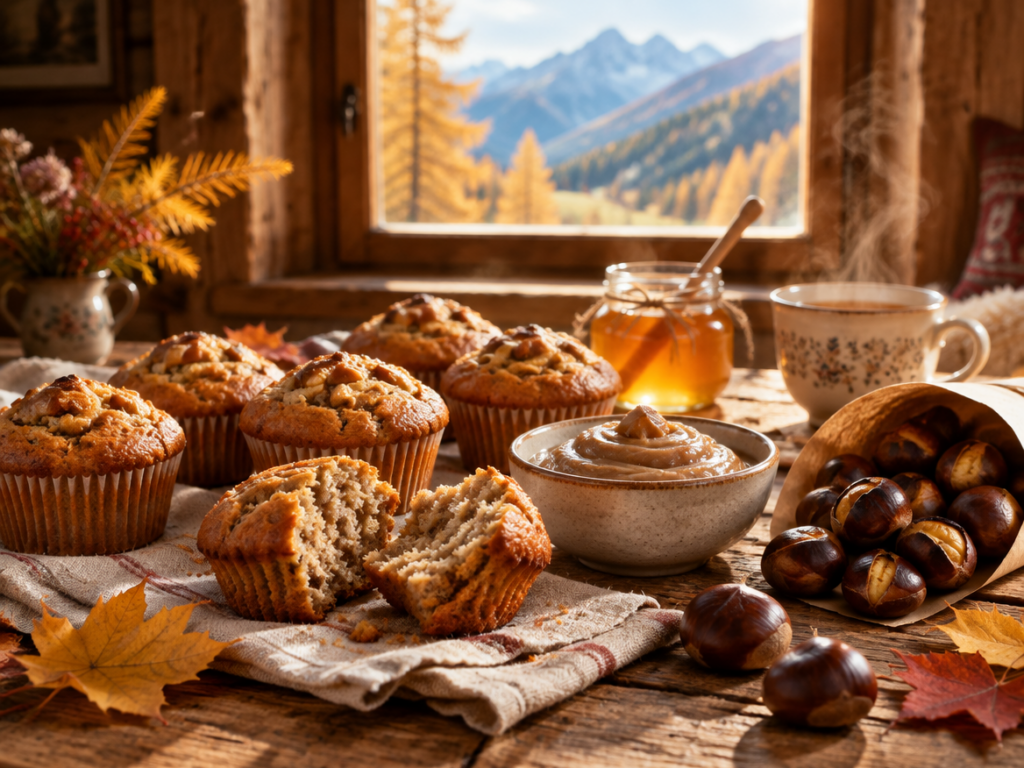
When the first chestnut sellers fire up their little ovens in Salzburg’s old town, we know autumn has truly arrived. The smell of roasting chestnuts drifts through the lanes, you warm your hands on a small paper bag and peel the hot chestnuts as you stroll. Today we’re bringing that feeling into the kitchen with moist spelt chestnut muffins made with freshly milled flour.
They’re quick to make, not too sweet and wonderfully nutty. Perfect for an afternoon snack, Sunday coffee or as a little gift for the neighbours.
For many of us, the chestnut stand is simply part of the colder months. As soon as the days get shorter, the chestnut roasters (in Austria we call them Maronibrater) are back in their spots around town, and their scent keeps us company well into winter. At home in Hallein it’s almost a little ritual: whoever goes into town brings a bag of chestnuts home.
Sweet chestnuts, or Maroni as we say in Austria, are the fruit of the sweet chestnut tree. Many of them come from the south, for example from Italy. In Austria, sweet chestnut trees grow mainly in milder regions such as Styria. Roasted, they taste mild and slightly sweet; cooked and puréed, they turn creamy and smooth. And it’s exactly this purée that makes our muffins so moist.
Spelt and chestnuts make a lovely pair. Freshly milled spelt has a mild, slightly nutty flavour, and the whole kernel, including germ and bran, ends up in your flour. The chestnut purée adds a gentle sweetness and keeps the muffins soft even the next day.
A little tip from our kitchen: freshly milled wholegrain flour absorbs a bit more liquid than shop-bought white flour. So let the batter rest for a few minutes before baking. That gives the flour time to soak up the liquid, and your muffins turn out especially light.
Important: the chestnuts themselves don’t go into your grain mill. The mill is made for dry grain. You can buy chestnut purée ready-made or make it easily in a pot with a hand blender.
For 12 muffins you’ll need a muffin tin with paper cases. All in all, you’ll be done in about 45 minutes.
If you’d rather make the purée yourself: score about 300 g fresh chestnuts with a cross on the rounded side and simmer them in water for around 20 to 30 minutes until soft. Peel them while still warm, including the thin brown inner skin, and purée them finely with a splash of milk. In autumn, many supermarkets also sell ready-made chestnut purée and vacuum-packed peeled chestnuts.
Preheat your oven to 180 °C (top and bottom heat). Mill the spelt finely and mix the flour in a bowl with the baking powder, salt and cinnamon. You’ll notice right away how lovely freshly milled flour smells.
In a second bowl, whisk the chestnut purée with the eggs, sugar, oil and milk until smooth. Add the flour mixture and stir just until everything is combined. If you like, fold in the chopped chestnuts now. Let the batter rest for 10 minutes.
Place the paper cases in the muffin tin and spoon in the batter, filling each about two-thirds full. If you like, top each muffin with a small piece of chestnut.
Bake the muffins on the middle shelf for 20 to 25 minutes until golden brown. Test with a skewer: if it comes out clean, they’re done. Let them rest in the tin briefly, then cool on a wire rack.
Our tip: well wrapped, the muffins stay moist for two to three days. They also freeze beautifully, so you’ll always have a little autumn treat on hand.
For decoration, or just for nibbling, you can roast chestnuts in the oven too. Score them with a cross on the rounded side so they don’t burst, and lay them cut side up on a baking tray. At around 200 °C they need about 20 to 25 minutes, until the shells split open. An ovenproof dish of water in the oven keeps them nice and moist. Afterwards, wrap them in a tea towel for a few minutes and they’ll be easier to peel. With a cup of tea alongside, your kitchen will feel almost like Salzburg’s old town in autumn.
Fancy more autumn baking? Have a look at our pumpkin bread with freshly ground spelt.
For us, the best part of autumn baking is when the freshly milled spelt trickles into the bowl and, shortly afterwards, the whole kitchen smells of chestnuts and cinnamon. With your Salzburg grain mill you mill your flour exactly when you need it, as fine as your recipe calls for.
Give it a try, and tell us how you liked the chestnut muffins. We’d love to hear from you!