

History and Origins
The roots of the Maypole tradition stretch far back into the Germanic and Celtic past. As early as pre-Christian times, trees were revered as sacred symbols of nature. The erected tree was regarded as a connection between earth and sky, as a source of strength for humans and animals. Over the centuries, pagan traditions blended with Christian customs, and the maypole became an integral part of rural life.
The first written mention of a Maypole in Germany dates back to the 14th century. Since then, the custom has spread throughout Central Europe and developed its own distinct character in every region.<\
The stripped tree trunk – a symbol of purity
Traditionally, a particularly straight and tall spruce or fir tree is selected for the Maypole. The tree is felled, stripped of all branches, and completely debarked—the bare, smooth, light cream-colored trunk is its unmistakable hallmark. At the top sits a lush wreath of fresh fir branches, adorned with red-and-white ribbons, guild insignia, and symbols of the village community’s crafts.<\
The Erecting – A Celebration of Community
The erection of the maypole is a communal event par excellence. Men and women from the village come together to raise the heavy trunk to a vertical position using muscle power, wooden poles, and ropes. Accompanied by brass band music, a beer tent, and the scent of freshly baked pastries, the Maypole is erected amid the cheers of the crowd.
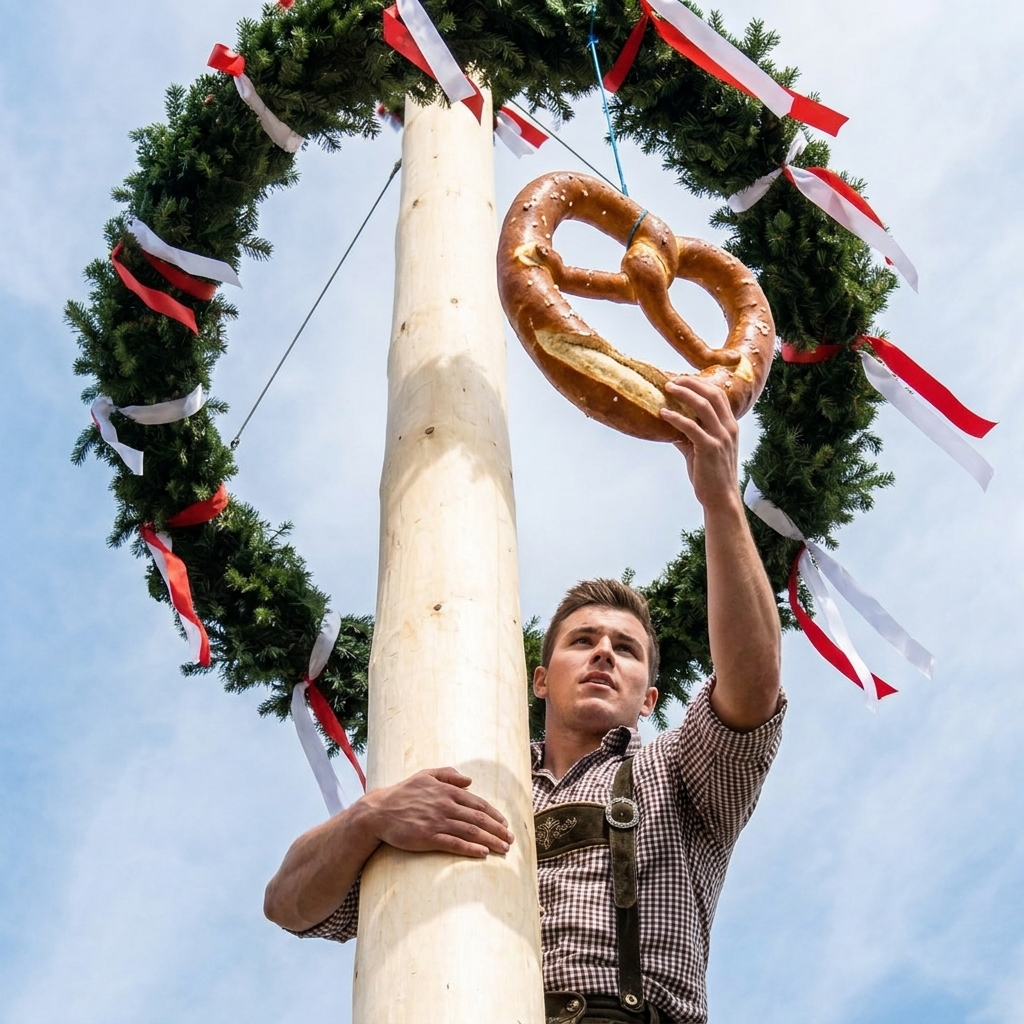
Particularly spectacular is the traditional Maypole climbing: Brave young men—often in lederhosen and barefoot—attempt to climb the smooth, greased trunk to grab the prizes attached to the top. Pretzels, sausages, and other delicacies hang temptingly from the wreath, waiting for the courageous climber who earns them.
The Pretzel on the Maypole
The pretzel plays a special role in Maypole climbing. As a traditional Bavarian pastry, it symbolizes craftsmanship, down-to-earthness, and enjoyment. Whoever manages to climb the smooth trunk all the way to the wreath and snag one of the coveted pretzels not only enjoys a sweet reward—they also reap thunderous applause from the crowd and the respect of the entire village community.
The pretzel, baked from freshly ground flour—such as that supplied by the Salzburg Grain Mills—symbolizes the cycle of nature, craftsmanship, and enjoyment: from grain to flour to dough, from the mill through the oven and up to the Maypole.
A Living Tradition
Even today, in the 21st century, the Maypole is far more than a nostalgic relic. In hundreds of villages and towns across Bavaria, Austria, and South Tyrol, it is erected every year on May 1 with great effort and genuine enthusiasm. It connects generations, strengthens a sense of community, and reminds us that some traditions are simply too beautiful to disappear.
“The Maypole doesn’t just stand there—it is a living symbol of a community standing together.”