


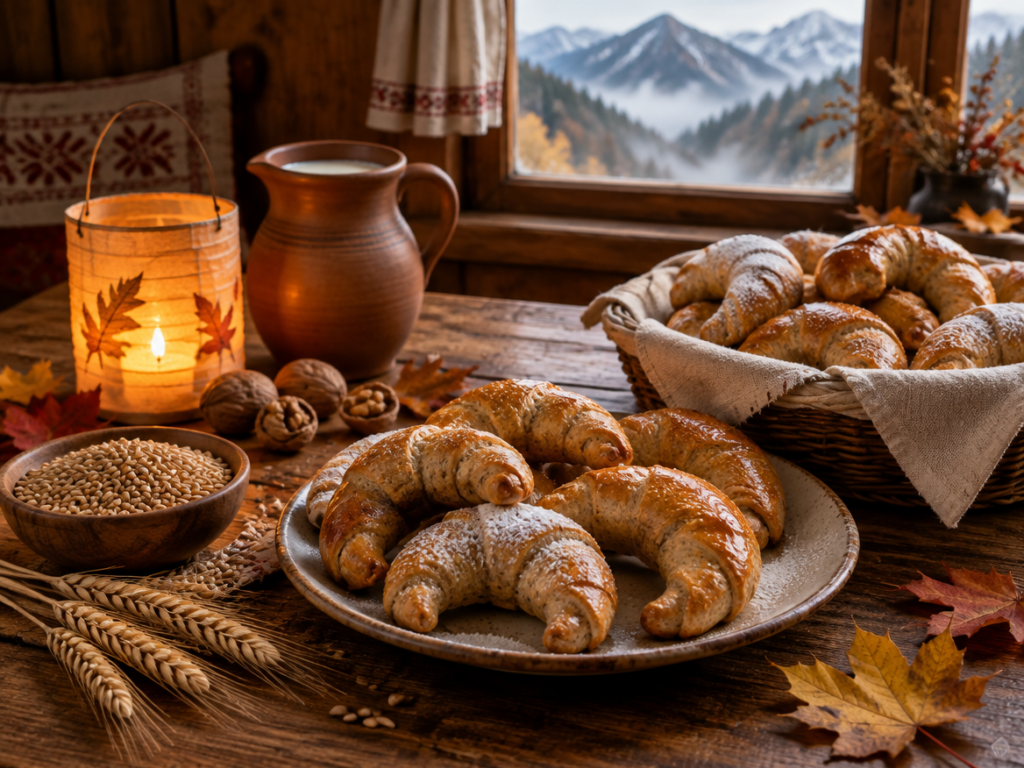
When it gets dark early in November, little lights suddenly start glowing all over the Salzburg region: children walk through the streets with their home-made lanterns, singing songs for St. Martin. For us, that evening also calls for something warm from the oven. Today we’ll tell you what St. Martin’s Day is all about and show you how to bake St. Martin’s crescent rolls, our Martinikipferl, with freshly milled spelt.
Here in Hallein, the kitchen smells of yeast dough around 11 November every year. And as soon as the first golden crescents come out of the oven, everyone suddenly appears, wanting to “just try one”.
On 11 November we remember St. Martin of Tours. He lived in the 4th century and started out as a soldier. You probably know the most famous story about him: on an icy winter’s day, he met a freezing beggar at the city gate. Without hesitating, Martin cut his cloak in two with his sword and gave half to the man. He later became Bishop of Tours.
Geese play a part in his legend too. It’s said that Martin didn’t want to become a bishop at all and hid in a goose shed. But the geese cackled so loudly that they gave him away. That may be one reason why roast goose, the Martinigansl, appears on so many Austrian inn menus around St. Martin’s Day.
Today most people think of the lantern procession first. Nurseries, schools and parishes start making lanterns weeks in advance, and on St. Martin’s evening the children set off with their glowing lights. It’s all about what Martin stood for: sharing with one another and being a light for others.
In the past, St. Martin’s Day was also an important date in the farming year. The harvest was in, the work in the fields was largely done, and in many places rents and dues were paid around this day. Afterwards came the quieter part of the year, slowly leading towards Advent and Christmas. One more reason to sit down together for a good meal.
In some places, crescent-shaped yeast pastries are baked for St. Martin’s Day. People like to say their curved shape is a reminder of the horseshoe of Martin’s horse. Nobody knows for certain whether that’s really where they come from, but it’s a lovely thought. And it’s even lovelier when children share their crescent after the lantern walk, just as Martin shared his cloak.
Our crescents are soft and fluffy, only lightly sweet, and taste just as good plain as with jam. Freshly milled spelt gives them a delicate, nutty flavour. For about 12 crescents you’ll need:
Mill the spelt finely and tip it into a large bowl. Dissolve the yeast with a teaspoon of the sugar in the lukewarm milk. Add the milk, remaining sugar, salt, egg, lemon zest and soft butter to the flour and knead for 8 to 10 minutes into a smooth, soft dough. Freshly milled wholegrain flour absorbs a little more liquid, so add a splash more milk if the dough feels too firm.
Cover the bowl with a tea towel and leave the dough in a warm place for about 60 minutes until it has visibly grown. In autumn, ours likes to sit next to the tiled stove.
Divide the dough in half and roll each piece out on a lightly floured surface into a circle about 30 cm across. Cut each circle into 6 wedges, like a cake. If you like, place a small dollop of jam or plum butter at the wide end of each triangle.
Roll up each triangle from the wide end towards the tip and gently bend the ends into a crescent. Place them on a lined baking tray, cover and leave to rise for another 20 minutes while you preheat the oven to 180 °C (top and bottom heat). Brush with the egg yolk and bake for 15 to 18 minutes until golden brown.
Our tip: the crescents taste best while still slightly warm. If you like them sweeter, dust them with a little icing sugar once cooled. And if you enjoy this dough, try our All Saints’ Day bread with freshly milled spelt too.
These crescents are a wonderful recipe to bake with children. Rolling, cutting and shaping is usually great fun for little ones, and the crescents don’t all have to look the same. Pop a few in a basket and take them along to the lantern walk, or bring some round to your neighbour. Just as St. Martin would have done.
With your Salzburg grain mill you mill your spelt exactly when you need it and bring the full flavour of the whole kernel into your crescents. That’s how a simple yeast dough becomes a little autumn celebration. We wish you and your family a glowing St. Martin’s evening and lots of joy baking!
Facebook teaser:
When the lanterns glow, our kitchen smells of fresh yeast dough! For St. Martin’s Day on 11 November we’re baking crescent rolls with freshly milled spelt: soft, lightly sweet and perfect for sharing after the lantern walk. Discover the story behind the tradition and our 4-step recipe here: https://getreidemuehle.com/en/recipes/st-martins-day-crescent-rolls-spelt/ #StMartinsDay #CrescentRolls #AutumnBaking #Salzburg #FreshlyMilled