

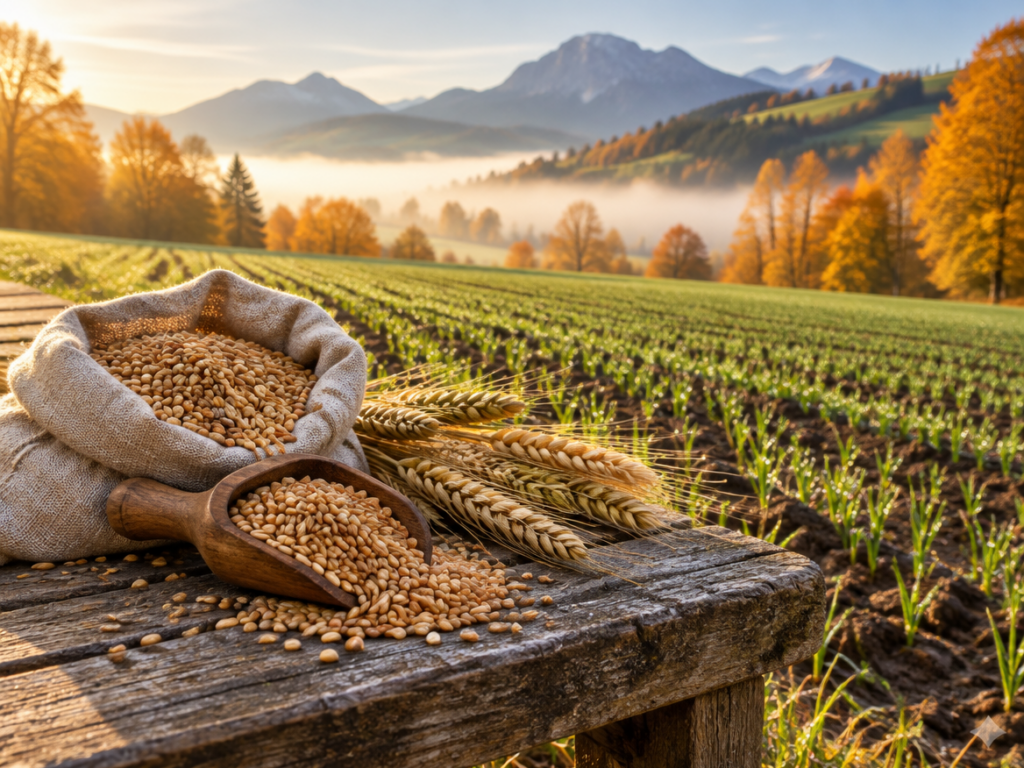
If you drive through the Salzburg countryside early on an October morning, mist often still hangs over the fields. Look a little closer and you’ll spot fine green rows on some freshly tilled plots, barely a finger long. That’s winter grain: wheat, rye and spelt sown now in autumn, wintering under the snow and ripening next summer. Today we’d love to take you along on this long journey from the field to your grain mill.
Here in Hallein, it reminds us every year how much patience goes into a single loaf of bread. The grain you’ll mill next autumn is only just starting to grow.
Winter grain, or winter cereals, are varieties sown in autumn that spend the winter in the field as young plants. What makes them special: many of them actually need the cold. Only after a longer cool spell in winter do they form their ears in spring. Experts call this vernalisation. Sow winter wheat in spring and it often won’t really get going.
The main winter cereals are:
Oats are quite different: they’re a classic spring crop and are only sown in spring, just like spring barley and millet. So when you roll your oat flakes in the morning, that grain comes from a field that was sown in March or April.
Depending on the variety, location and weather, sowing runs from late September into November. Barley and rye usually go into the ground a little earlier, wheat and spelt a little later. After a few days to a few weeks the kernels sprout, and by the first frost the young plants have grown a few leaves and begun to tiller, meaning they form side shoots.
In winter, growth almost stops. A blanket of snow is actually a blessing for the little plants, protecting them from icy frosts like a warm duvet. Hard frost without snow is tougher. And here in the mountains, there’s hardly a lovelier sight than a snowy field with next year’s bread already sleeping beneath it.
As soon as the soil thaws and the days get longer, the plants take off. They keep tillering, shoot upwards, and in May and June the ears emerge from the stalks. Then come flowering and grain filling.
When the fields turn golden and the kernels harden, it’s time to thresh, usually in July and August. The grain is then cleaned, dried to the right moisture level and stored. And that’s where the part of the journey that ends in your kitchen begins.
By the way, the Salzburg region is mostly meadows, pastures and alpine pastures. You’ll see grain fields more often in the Flachgau area to the north and further out towards Upper Austria.
You might be wondering: if grain is only harvested once a year, how can my flour be fresh in February or May? The answer lies in the kernel itself. A whole kernel is a small, perfectly packed pantry. The bran protects the germ and the endosperm, and as long as the kernel is intact and dry, its valuable nutrients stay well protected.
The kernel is only opened up when you mill it. From that moment, oxygen reaches the fats in the germ, and the flour gradually loses its aroma. That’s why we prefer to mill just before baking. We’ve explained why shop-bought wholemeal flour can even turn bitter over time here: Why store-bought whole wheat flour turns bitter — and freshly milled doesn’t.
Look for well-cleaned, food-grade grain, ideally from a farmer or supplier you trust. The kernels should be dry, flow freely and smell pleasantly of grain, never musty.
Larger amounts are best kept in linen or paper sacks or a wooden box. For everyday use in the kitchen, jars or tins with lids work well too, as long as the grain is really dry.
A pantry, a dry cellar or a cool cupboard are ideal. Avoid spots next to the cooker, radiator or washing machine, as grain doesn’t like warmth or moisture at all.
Take a look at your supply now and then: does the grain smell good, and have no little guests such as pantry moths moved in? Then simply mill as much as you need for your bread, biscuits or breakfast.
Our tip: stored well, whole grain keeps for many months, often considerably longer. So you can buy your favourite grain in a larger quantity and be set for the whole winter.
For us, this is where the circle closes every year: outside, the fields are being sown, and inside, last harvest’s grain trickles freshly milled into the bowl. With your Salzburg grain mill you bring exactly that moment into your kitchen. You mill wheat, rye and spelt when you need them, with the whole kernel and all its flavour in your flour. And for breakfast, your Salzburg flaker turns oats from the spring field into fresh flakes.
Next time you pass a freshly sown field, do stop for a moment. Next summer’s bread is growing right there. We think that’s a lovely thought for a misty autumn day.